On wanting...
And what drives those wants.

Dear friend,
For a long time, I was this confident child who knew what she wanted from the world. I might never have mentioned those aspirations out loud, but things were pretty clear in my head; until life happened!
Let’s take a closer look at this.
As we get exposed to more people, things, and experiences, our expectations from life and even ourselves for that matter, get altered in unexpected, unimaginable ways. It is hard to predict the magnitude of these alterations because sometimes they are quite noticeable and in some circumstances, they lurk around, coming to light only in the hindsight.
Why am I talking about this?
A few months ago, I found myself in a spot when I wanted so many things while I couldn’t visualise myself working in the direction of any of those things. It wasn’t because I didn’t want to work on them, but because I couldn’t prioritise my desires. I couldn’t pick one over the other.

Of late, I reach out to this person I met via Twitter every time I find myself too caught up in the web of my thoughts. They have not only been patient with me, but have also offered their valuable advice time and again.
I approached them with this dilemma too, and as always, they had something valuable to offer. They redirected me to a book this time — Wanting.
If you have known me for a while (also includes following me on social media), you know I have been reading a lot lately. Wanting is undeniably one of the most important books I have read in a while, so, it only makes sense to share the impact with you.
The next section is going to be more or less about my learnings from the book. I do not wish to serve book summaries through this newsletter, but I’m sure this one will turn out to be helpful in many ways.
Wanting: The Power of Mimetic Desire
There are always models of desire. If you don’t know yours, they are probably wreaking havoc in your life.
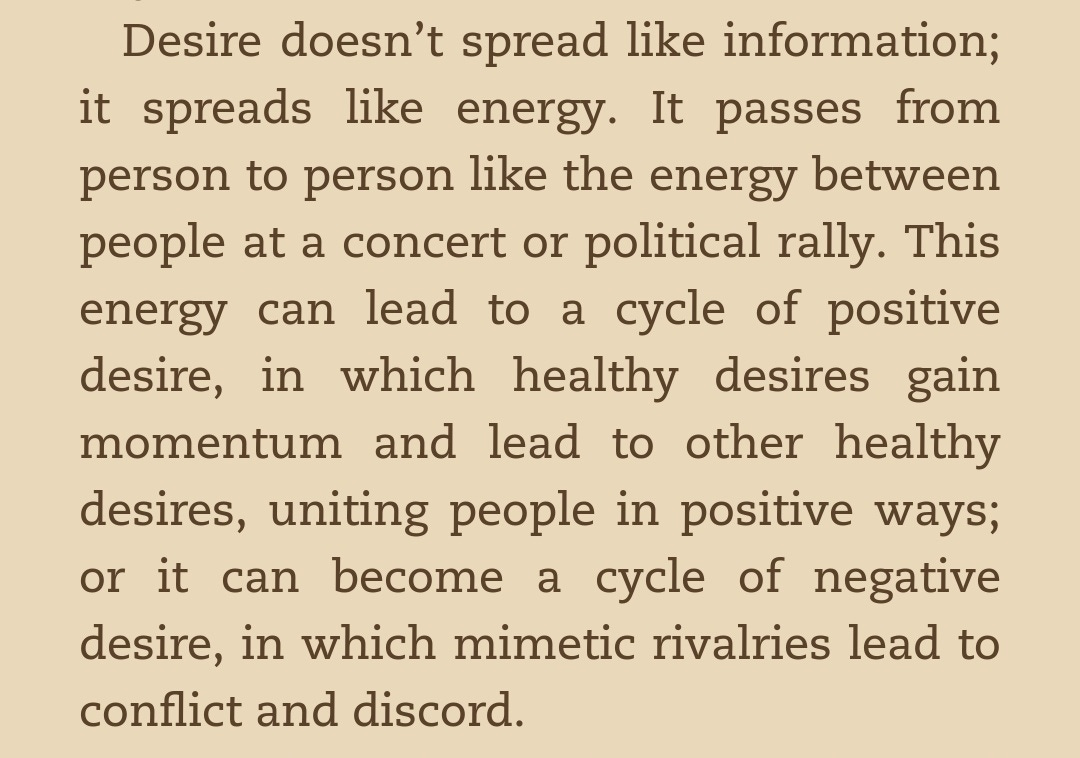
We like to believe that we have full control over our wants and desires without realising how imitation has always been an important aspect of human existence. What if I told you most of the things we find desirable (or undesirable) are influenced by models?
Luke, the author of the book, defines a model as a person or thing that shows us what is worth wanting.
The most common example of how our desires can be modeled is influencer marketing. Our chances of buying something increase several fold when we see our favourite celebrity recommending it. The impact of mimesis is not limited to mere materialistic things, it goes way beyond that. The idea behind this book is to help you understand how mimetic desire works and take control of it to create a better life for yourself.
We like to believe that we are immune from getting influenced. When we see a lot of people buying one thing, we might want to ‘prove’ that we are not influenced by getting something opposite. What we do not realise is that in doing so, even if we are not doing what’s expected of us, our desire continues to be influenced by the models.
The moral of the story is irrespective of how hard we try, it is difficult to not be influenced for the world is designed in such a way. Social media only makes it more difficult by exposing us to the desire of billions of people across the globe.
What we commonly call “social media” is more than media—it’s mediation: thousands of people showing us what to want and coloring our perception of those things.
The good news is we can choose our models once we become capable of identifying the good from the bad. Also, it is important to note that mimetic desire can be channeled to bring about good, it isn’t always bad.
While I cannot elaborate how desires work in a manner as it has been done in the book, I can bring to you the tactics that you can use to take control of your desires:
Identify the models in your life.
Find sources of wisdom that withstand mimesis.
Create boundaries with unhealthy models.
Use imitation to drive innovation.
Start positive flywheels of desire.
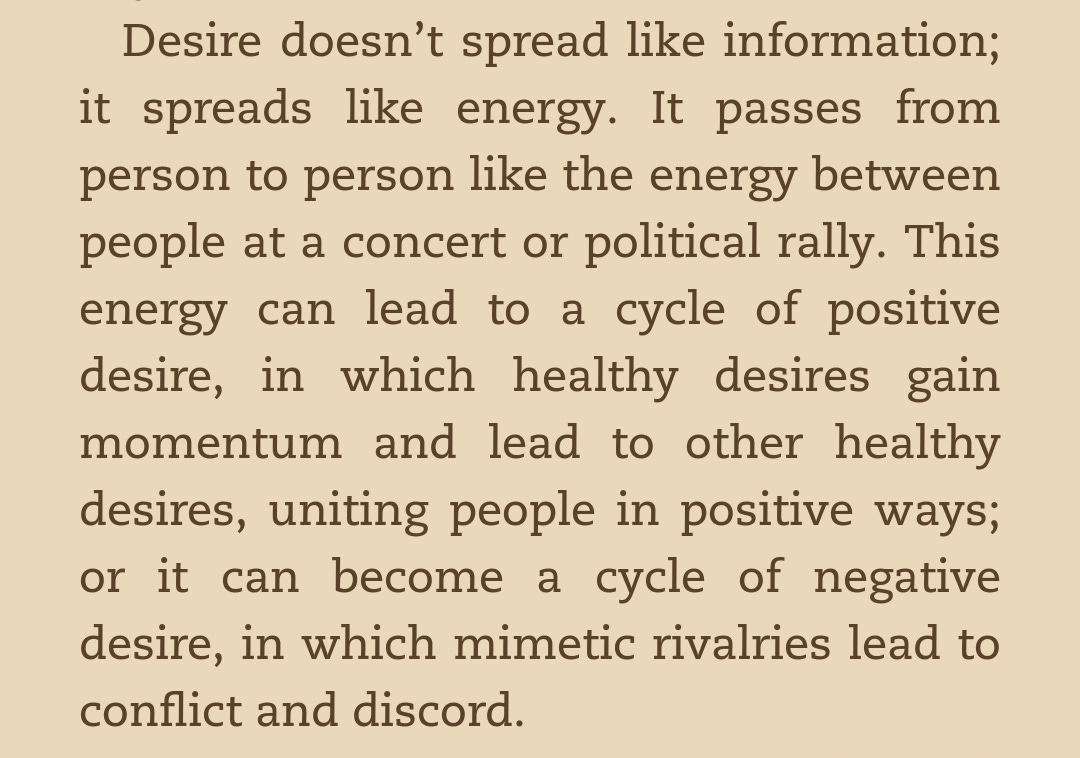
Flywheels of Desire Establish and communicate a clear hierarchy of values.
Arrive at judgments in anti-mimetic ways.
Map out the systems of desire in your world.
Put desires to the test.
Share stories of deeply fulfilling action.
Increase the speed of truth.
Invest in deep silence.
Look for the coexistence of opposites.
Practice meditative thought.
Live as if you have a responsibility for what other people want.
This is a great place for some further reading. This is a book I’d strongly recommend to everyone because understanding human behaviour is never a waste.
I am yet to practice the above-mentioned tactics, however, reading about mimetic desire already makes me feel more in control of my desires. I hope it has a similar impact on you too. Thank you for reading!
PS, this edition didn’t turn out to be as good as I wanted it to be because I am down with coronavirus. I hope it still manages to convince you to spend at least a few minutes thinking about your desires and what models them.
Wishing you happiness and good health
Surbhi ❤️
The fact that being a contrarian itself means that we're influenced - although in the opposite way - baffled me; hadn't noticed it this way before.
Also, to anyone looking for a quick intro to mimetic desire, I'd suggest to watch this short 2-min video (https://www.youtube.com/watch?v=kwLWDmh_cAo), which brings home the point in a brief and precise manner. ["Instead of being direct and autonomous ('I want this') our desire is triangular ('I want its', because my model wants it)."]
Thank you for the article, Surbhi! And wish you a speedy recovery :)
This is a wonderful piece👌. I wish you a speedy recovery.💐🌺